
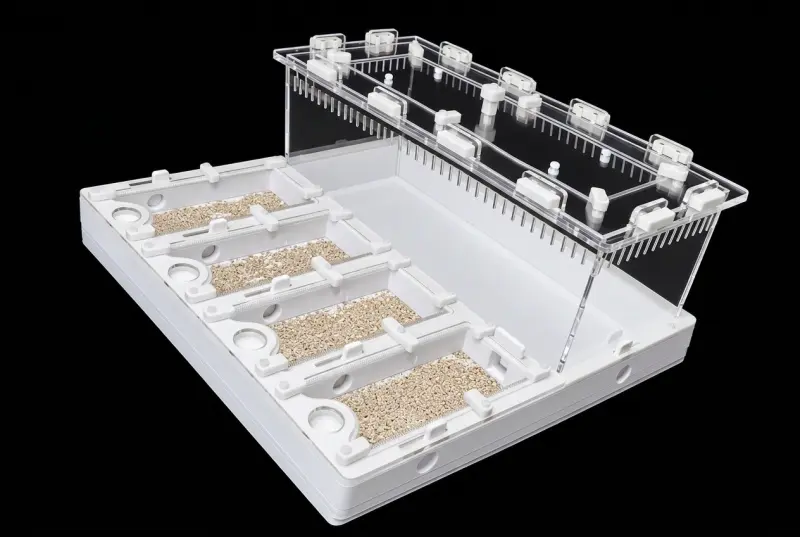
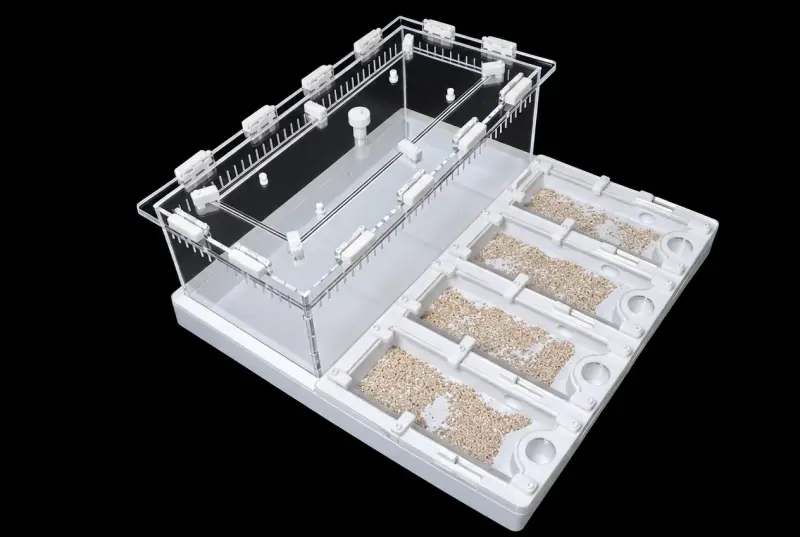
Description
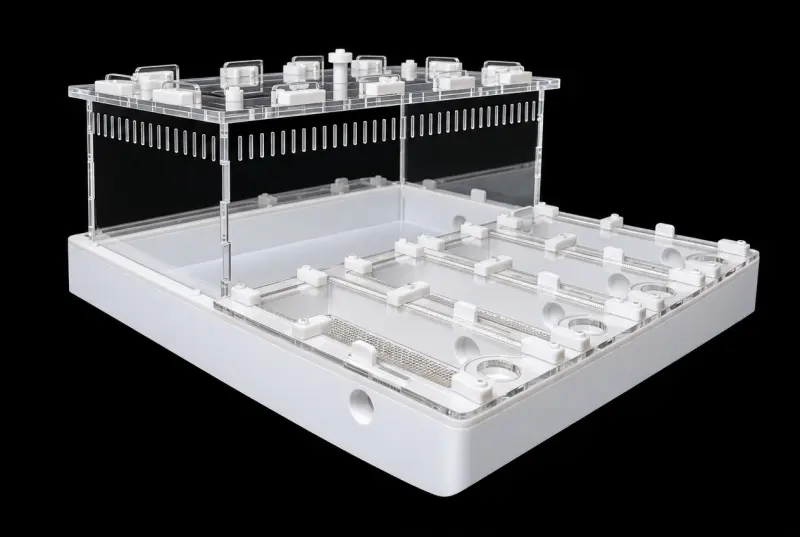
Core White is a professional formicarium in a white finish, built for large and predatory ants, including exotic species. Colonies like these call for a different approach to nest design: consistently high humidity, roomy chambers and a quick way to clear out prey remains. Rather than a starter incubator, this is a complete system for an established colony, with humidity set chamber by chamber and cleaning that never requires taking the whole nest apart. The white housing looks neat in any room and serves a practical purpose too: against the light background, scraps of organic matter and the first patches of mold stand out at once, so you can spot a problem before it spreads.
Materials and Assembly
The load-bearing frame and decorative panels are printed from white food-grade PETG plastic. This polymer was chosen for its moisture resistance: it is designed to cope with a permanently damp nest, keeps its shape and stays rigid under moderate heat, so the farm can be paired with a heat mat. By comparison, ordinary PLA plastic handles heat noticeably worse, while acrylic exposed to long-term high humidity can warp over time and develop a web of microcracks.
The chambers and arena are covered from above with clear food-grade German acrylic (plexiglass) 3 mm thick, giving you an unobstructed view of colony life. The parts are held together with white nylon screws that do not rust, so no traces of corrosion appear in the living chambers. The entire system comes apart via clips and screws, which makes maintenance and washing easier.
Specifications
- Overall size: 300 × 300 mm
- Arena: 142 × 280 mm, height 130 mm
- Gypsum: medical-grade G-23, 10 mm layer
- Height above gypsum: 20 mm
- Relief: sand applied over the gypsum
- Configuration: partially gypsum, variant A
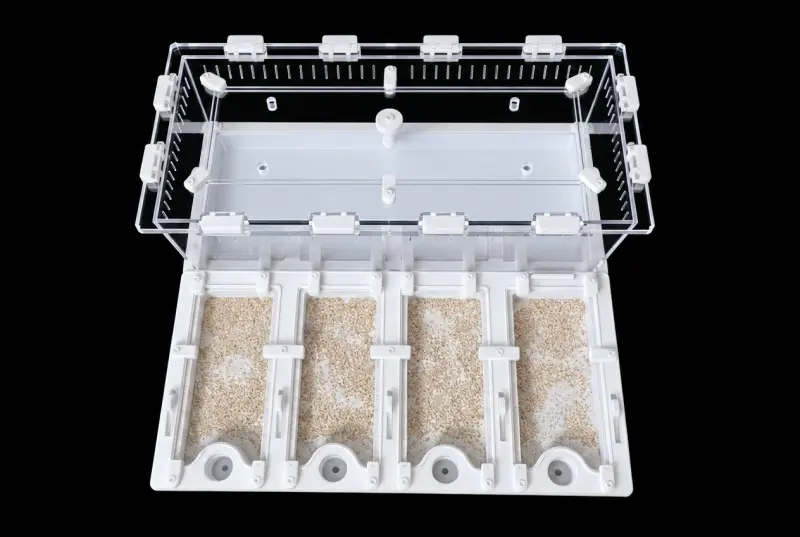
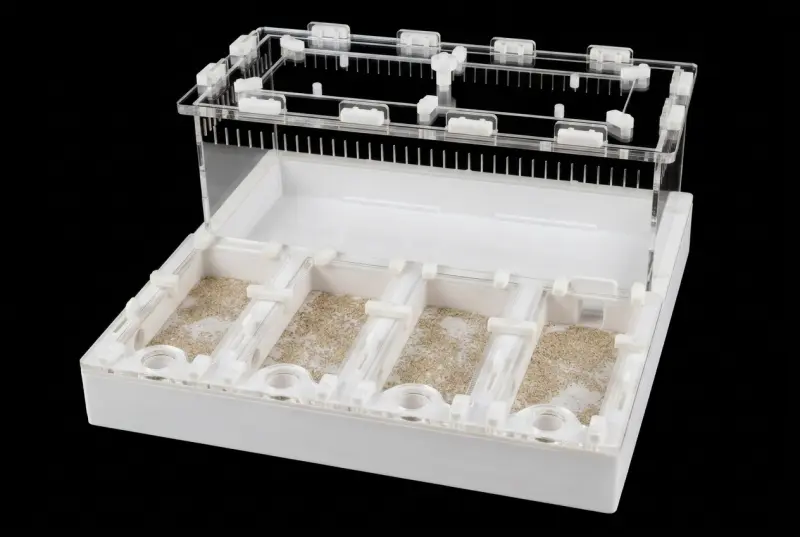
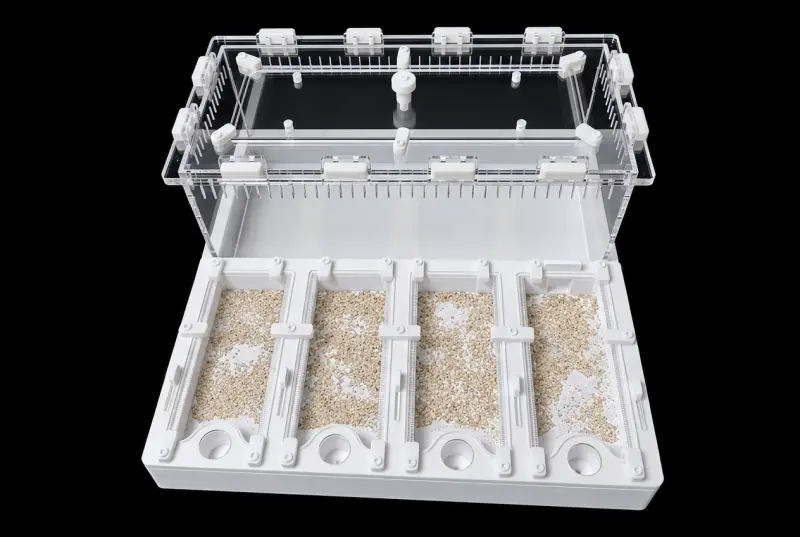
- Chambers: 4, all with gypsum
- Humidification zones: 4, each chamber has its own test tube auto-humidification
- Doors between chambers: sliding, non-removable
- Arena door: removable, between the arena and the first living chamber
- External doors: 2 on the chambers and 1 on the arena
- Chamber lids: removable, with latches
- Arena protection: double lid
- Fasteners: white nylon screws, rust-free
- Materials: white food-grade PETG plastic, food-grade German acrylic (plexiglass) 3 mm
Cleaning Without Dismantling
Predatory ants drag their prey straight into the nest, and in a humid environment leftover insects quickly begin to rot and grow mold. That is why each of the four chambers has its own removable lid with a latch. Simply slide back the lid above the soiled chamber, pick out the remains with tweezers and close it again: neighboring chambers and the brood stay untouched, and the colony is barely disturbed.
The chambers are linked by sliding, non-removable doors. Opening them one at a time lets you expand the living space gradually as the colony grows, without rebuilding the farm.
Humidity Under Control
The core of the microclimate is a solid layer of medical-grade G-23 gypsum 10 mm thick. Although the model belongs to the partially gypsum category, all four chambers have a gypsum base, not just part of the nest.
What separate auto-humidification gives you:
- each chamber draws water from its own test tube, for four independent zones in total;
- by connecting tubes only to the chambers you choose, you create a humidity gradient inside the nest;
- for example, two chambers can be kept moist for raising larvae while the rest stay dry for storing cocoons.
For longer trips, arena humidification can be supplemented with a separately purchased water tower.
Sand and Space
A layer of sand is applied over the gypsum to create a natural relief. For many exotic predators this is an important detail: their larvae grip the sand grains while spinning a protective cocoon. With 20 mm of height above the gypsum, large workers have enough room to move freely inside the chambers.
Suitable Ants
The farm is designed for the following genera and species:
- Harpegnathos venator and Harpegnathos saltator;
- Odontoponera, Odontomachus and Myrmecia;
- Paraponera clavata;
- Hypoponera, Pachycondyla and Ectomomyrmex;
- Novomessor and moisture-loving Camponotus.
Arena and Escape Protection
The spacious 142 × 280 mm arena, 130 mm high, is closed with a double lid. Apply a slippery anti-escape coating to the inner frame and you can feed the colony and tidy the arena calmly, without worrying about ants getting out. A removable door separates the arena from the first living chamber.
Moving In and Expanding
Two external doors on the chambers and one on the arena make it easier to house or relocate a colony. They also let you connect the system to other modules, for example a starter mini-module incubator with 10 mm gypsum, where a single queen can found her colony in peace before the family moves into Core White.
FAQ
Why does each chamber have its own removable lid?
Predators bring prey into the nest, and in the humid conditions above 10 mm of gypsum, leftovers mold fast. A separate lid lets you remove debris with tweezers only where it has appeared, without disturbing the brood in neighboring chambers.
How does test tube auto-humidification work?
Each chamber connects to its own water-filled test tube. You decide which sections to moisten: for instance, supply water to two chambers for raising larvae and leave the others dry for cocoons.
Why is there sand on the gypsum?
Species such as Harpegnathos and Paraponera clavata rely on natural substrate: their larvae use sand grains as anchor points when spinning cocoons. The sandy relief also brings the nest environment closer to natural conditions.
Why PETG for the housing instead of acrylic?
Tropical species need high humidity, and under constant dampness acrylic can warp over time and crack at stress points. PETG is an impact-resistant food-grade polymer that handles these conditions well and keeps the housing's geometry for a long time.