
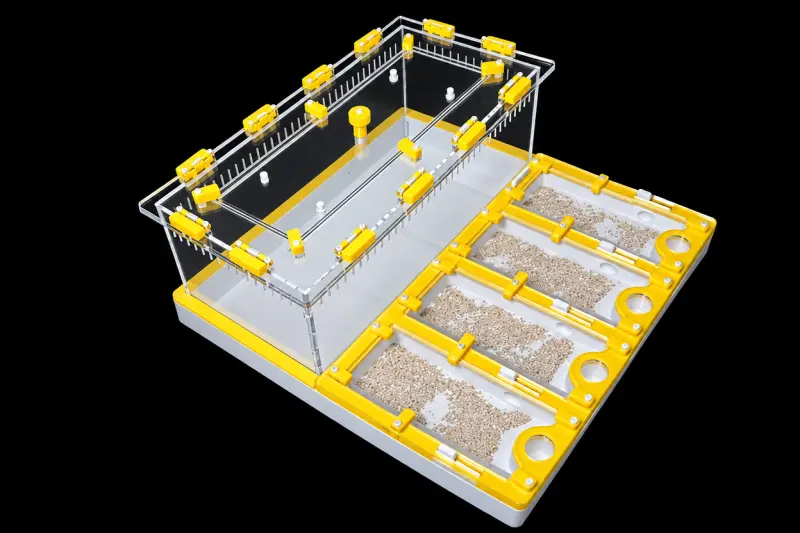
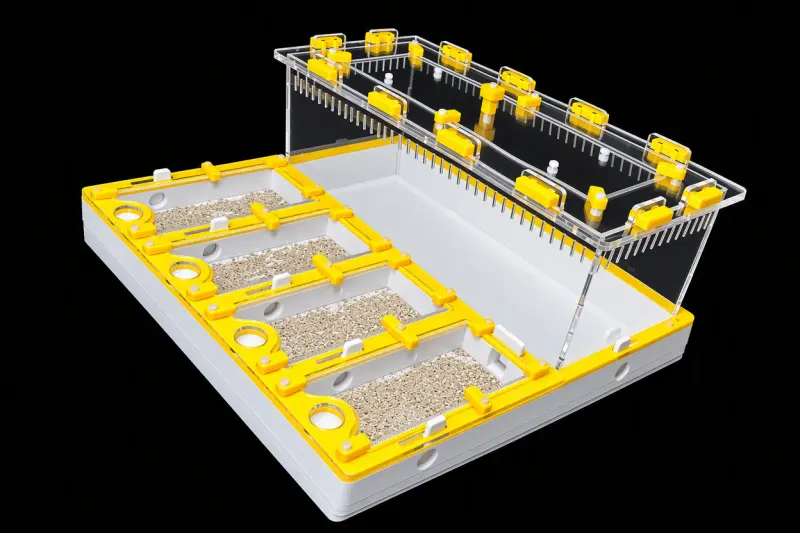
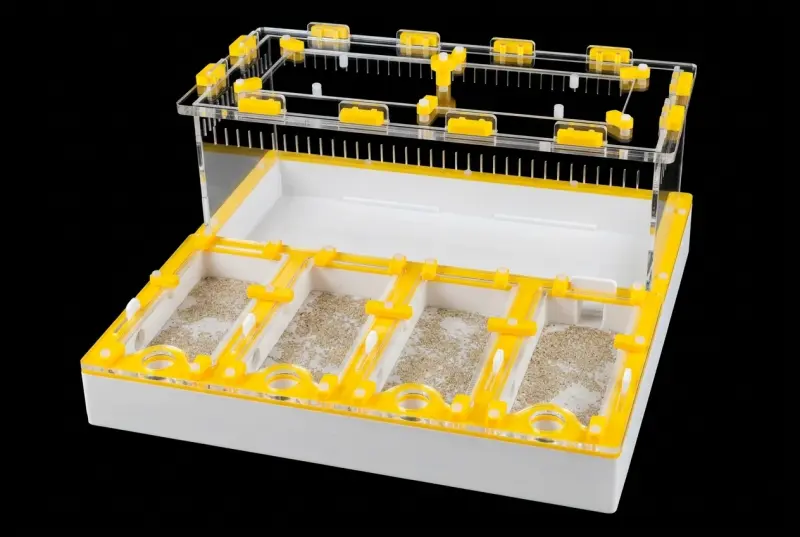
Description
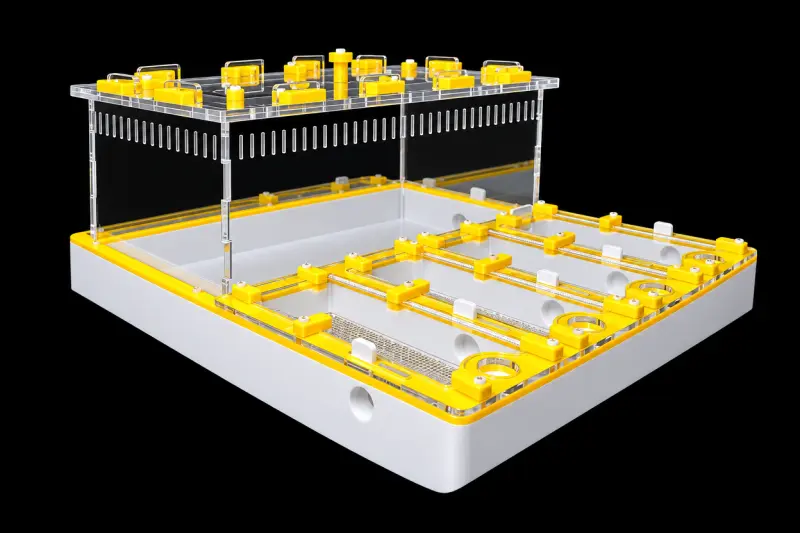
Core Yellow is a professional formicarium built for keepers of predatory, exotic and large ant species. Ponerines and other giants rarely do well in standard setups: they need high humidity, generous headroom above the substrate and a fast way to clear away prey remains. This model is engineered around exactly those demands — humidity tuned chamber by chamber, convenient spot cleaning and dependable escape protection for the colony.
Housing Materials
Predatory species need consistently high humidity, so every material here was chosen with constant moisture in mind. The load-bearing frame and the yellow decorative panels are printed from food-grade PETG plastic. This polymer resists moisture, does not swell when damp and, unlike heat-sensitive PLA, can be used together with a heat mat.
- Frame and panels — yellow food-grade PETG plastic.
- Top glazing — clear food-grade German acrylic (plexiglass), 3 mm thick.
- Fasteners — white nylon screws that do not rust or corrode in a humid environment.
Specifications
Key parameters of the model:
- Overall size: 300 × 300 mm.
- Arena: 142 × 280 mm, height 130 mm.
- Gypsum: medical-grade G-23, 10 mm layer.
- Clearance above the gypsum: 20 mm.
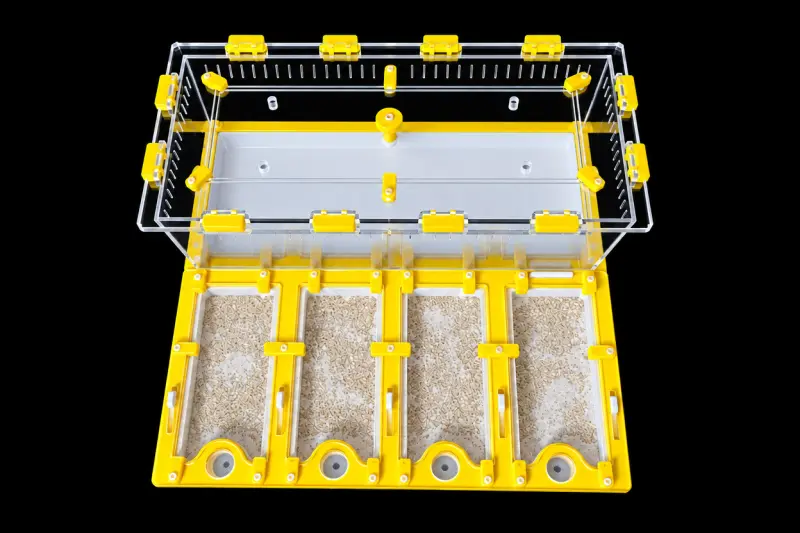
- Sand applied on top of the gypsum to create a natural relief.
- Configuration: partial gypsum, version A.
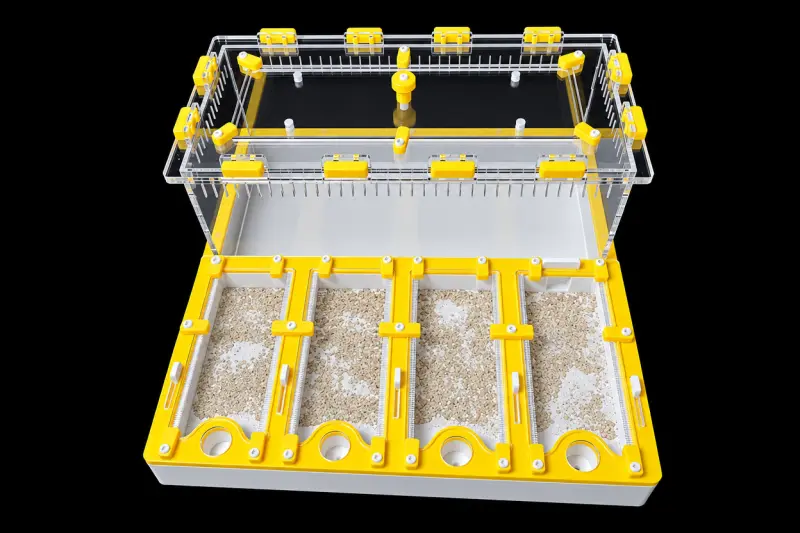
- Living chambers: 4, all four with gypsum.
- Humidification zones: 4 — each chamber has its own test-tube auto-humidification.
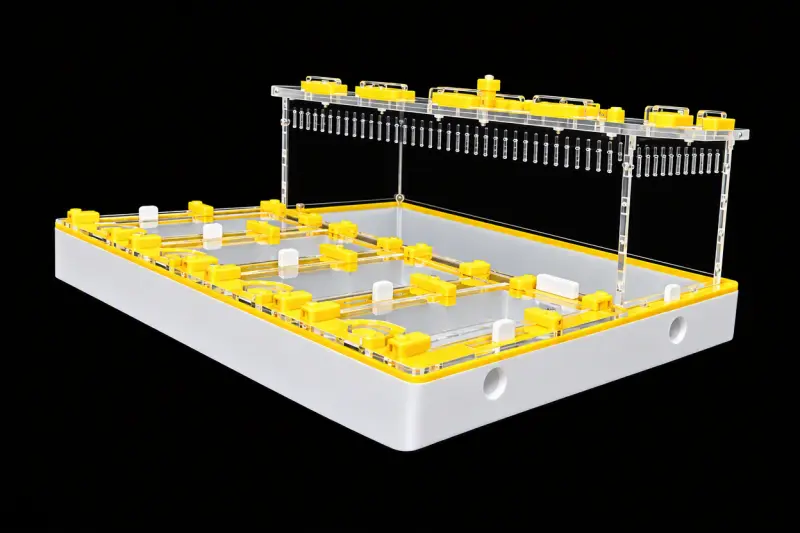
- Doors between chambers: sliding, non-removable.
- Door between the arena and the first living chamber: removable.
- External doors: two on the chambers and one on the arena, for moving a colony in or relocating it.
- Chamber lids: removable, with sliding latches, one for each chamber.
- Arena with a double lid; the whole system disassembles completely and is held together by clips and screws.
Spot Cleaning
The biggest headache when keeping predators is organic waste. Uneaten feeder insects quickly turn moldy in a humid nest. That is why each chamber lid comes off on its own: slide the latch over the dirty compartment, pick out the leftovers with tweezers and close the lid again. The other chambers stay untouched, so the colony barely notices the intervention.
Sliding doors between the four living zones let you gradually open up new space for the ants or, conversely, restrict it to match the size of the colony.
Humidity and Relief
A solid block of G-23 gypsum, 10 mm thick, keeps the climate stable. On top of it lies a layer of sand that recreates a natural relief and gives larvae something to hold on to while they spin their cocoons. The 20 mm of clearance above the gypsum leaves large workers enough room to move around.
The key feature of the system is independent test-tube auto-humidification in each of the four chambers. You decide which compartments to moisten and build a humidity gradient that matches the colony's needs. For self-sufficient humidification of the arena, a separate water tower can be added.
Formally the model belongs to the partial gypsum category, yet all four of its chambers are fitted with gypsum.
Suitable Species
The formicarium is designed for the following genera and species:
- Harpegnathos venator and Harpegnathos saltator;
- Odontoponera, Odontomachus, Pachycondyla, Ectomomyrmex, Hypoponera;
- Myrmecia and Paraponera clavata;
- Novomessor;
- large, moisture-loving Camponotus.
Protection and Expansion
The spacious arena is closed with a double lid. Apply an anti-escape barrier to the inner frame, and you can feed the colony or carry out other tasks calmly, without worrying that workers will slip outside.
If you are starting with a single queen, it is convenient to house her first in a mini incubator module with 10 mm of gypsum. Once the colony has grown, the module docks to the Core farm through the external doors, and the ants can move into the main nest.
FAQ
Why does every chamber have its own removable lid?
Predatory ants drag prey straight into the nest. With a 10 mm gypsum layer the humidity inside the chambers is high, and leftover food goes moldy quickly. Separate latched lids let you remove waste with tweezers only where it has built up, without disturbing the brood in neighboring compartments.
How does test-tube humidification work?
Each chamber has its own auto-humidification, so the microclimate can be adjusted compartment by compartment. For example, you can connect water-filled test tubes to just two chambers to create a humid zone for larvae and keep the rest dry for storing cocoons.
Why is there sand on the gypsum?
Exotic predators such as Harpegnathos and Paraponera clavata need a natural substrate. Larvae cling to the sand grains while spinning a protective cocoon, and the relief brings the nest environment closer to natural conditions.
Why PETG for the housing instead of acrylic?
Tropical species need high humidity, and PETG is a moisture-resistant polymer that absorbs almost no water and does not swell. As a result, the frame keeps its shape under constant dampness. In this model, acrylic is used only for the top glazing.